SD-WAN and the Redefinition of Enterprise Connectivity
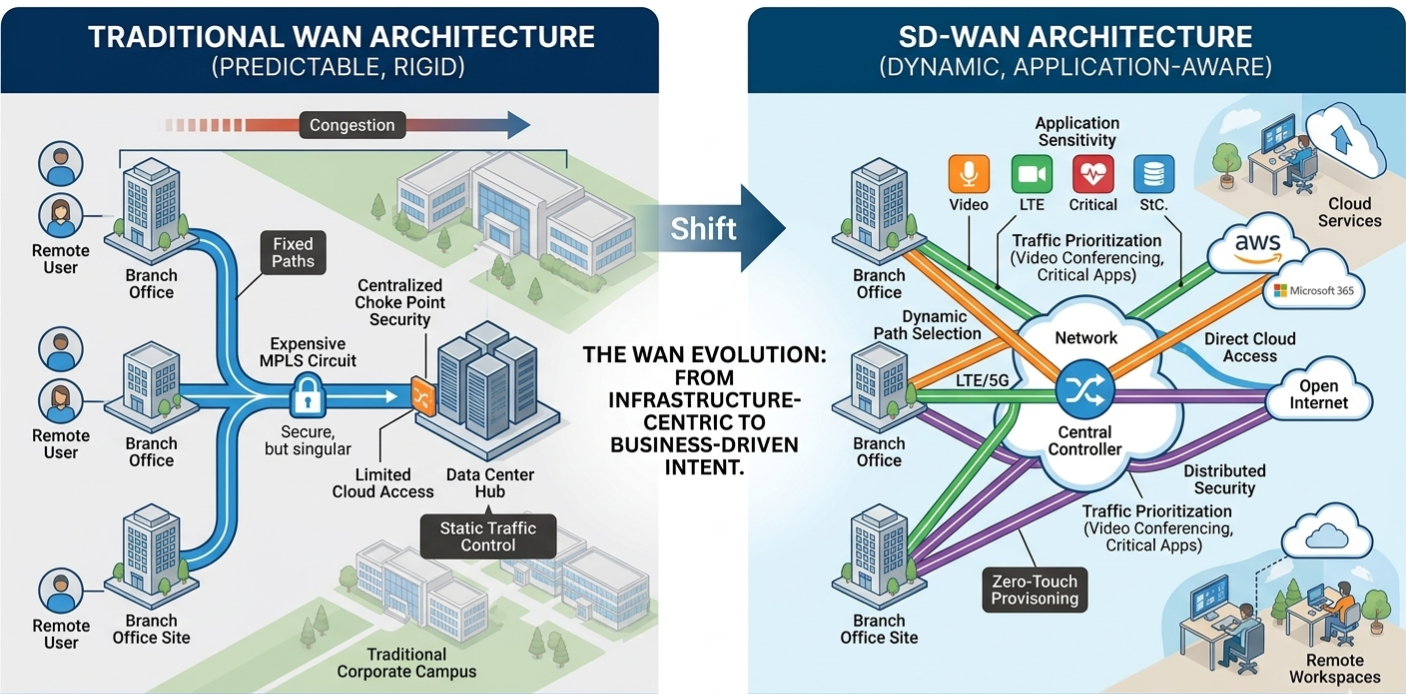
For decades, enterprise connectivity followed a predictable pattern. Branch offices were connected to a central data center through MPLS circuits. Traffic flowed through fixed paths. Security policies were enforced at centralized choke points. The architecture was stable, reliable, and relatively easy to control — but it was also rigid and expensive.
As organizations adopted cloud computing, SaaS platforms, and distributed workforces, this traditional WAN model began to show limitations. Applications were no longer confined to internal data centers. Employees were accessing Microsoft 365, AWS workloads, video conferencing platforms, and cloud-hosted CRMs from different geographies. Routing all traffic through a central hub created latency, congestion, and unnecessary cost.
This shift in application behavior forced enterprises to rethink WAN architecture.
Software-Defined WAN introduced a more flexible approach. Instead of relying solely on MPLS, organizations could combine broadband internet, LTE links, and private circuits into a unified overlay network. Control moved from device-level configuration to centralized policy management. The focus shifted from static routing decisions to dynamic path selection based on real-time conditions.
The real strength of SD-WAN lies in its intelligence layer. Policies can define how traffic should behave depending on application sensitivity. For example:
- Business-critical applications receive priority over bulk downloads
- Video conferencing traffic is routed through the lowest-latency link
- Backup traffic uses secondary circuits during off-peak hours
- Failover happens automatically if link performance degrades
This level of granularity was difficult to achieve with traditional WAN design without significant manual effort.
However, SD-WAN is not simply a cost-cutting mechanism. It represents a philosophical shift from infrastructure-centric networking to application-aware networking. Engineers are no longer configuring static routes alone; they are defining traffic intent aligned with business needs.
Consider a retail enterprise with dozens of geographically distributed stores. Under a legacy model, opening a new branch required provisioning circuits, manually configuring routers, and verifying connectivity through multiple checkpoints. With SD-WAN, zero-touch provisioning allows devices to connect automatically to a centralized controller, download policies, and integrate into the network with minimal intervention.
Yet abstraction does not eliminate technical responsibility. Beneath the controller interface, routing protocols, encryption standards, and performance metrics still govern behavior. A network engineer must understand how tunnels are formed, how overlay networks interact with underlay transport, and how quality-of-service policies influence throughput.
The growing enterprise adoption of SD-WAN is a reflection of business agility requirements. Organizations demand faster deployment, better visibility, and improved cost efficiency. Professionals who understand both traditional WAN design and software-defined overlays position themselves at the center of this transformation.
Connectivity is no longer just about linking sites. It is about intelligently managing traffic in a cloud-driven world. SD-WAN is not merely a technology upgrade — it is a structural evolution in how enterprises think about networking.