Network Automation: The Skill That Separates Engineers from Operators
In many traditional environments, networking work is repetitive. Devices are configured one at a time. Policies are copied and pasted. Backups are taken manually. Troubleshooting begins only after disruption. Engineers spend significant time executing tasks that, while necessary, do not scale efficiently.
Network automation challenges this model fundamentally.
Automation is not merely about writing scripts. It is about thinking in terms of desired state rather than manual execution. Instead of asking, “How do I configure this switch?” the better question becomes, “What configuration should every switch consistently have, and how can I enforce that automatically?”
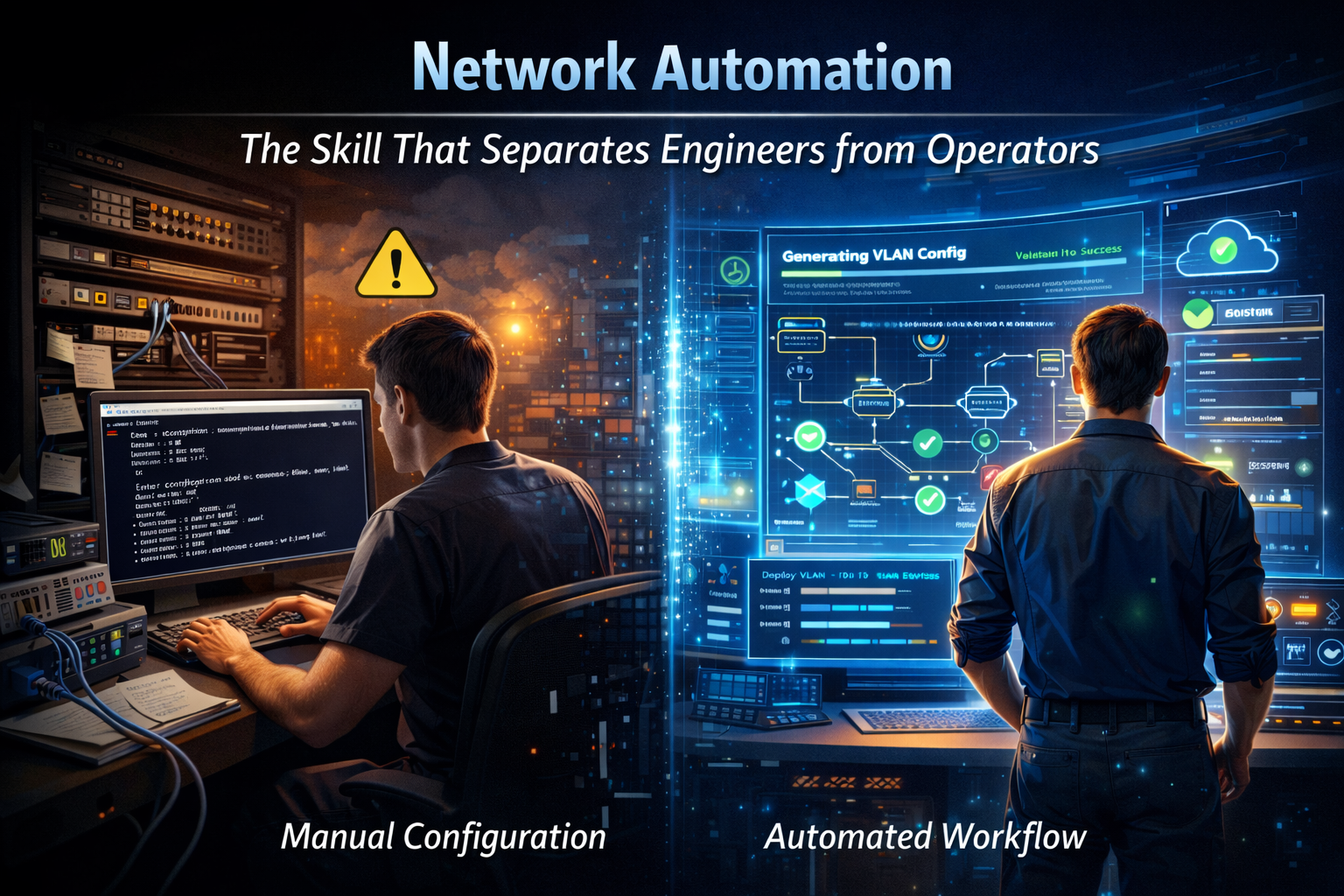
Consider a scenario in which a company needs to deploy a new VLAN across fifty branch switches. The traditional method involves logging into each device, entering configuration mode, applying commands, verifying output, and saving changes. Even if each device takes five minutes, the total time investment becomes substantial. The risk of inconsistency increases with fatigue.
With automation, the engineer defines logic once. A script or configuration management tool connects to each device, applies standardized commands, validates success, and reports exceptions. The same task that once consumed hours can now be executed in minutes.
The advantage is not only speed. It is precision.
Automation frameworks typically include validation checks. They confirm whether configuration has been applied correctly. They log execution details. They ensure that rollback mechanisms exist if deployment fails. This structured approach reduces human error and strengthens operational stability.
More importantly, automation transforms the engineer’s role from executor to designer. Instead of repeating commands, the engineer defines workflows:
- Which devices are included?
- What pre-checks must run?
- How should errors be handled?
- What compliance standards must be verified?
- How will success be measured?
This shift demands deeper thinking. It requires understanding both networking behavior and logical sequencing.
In enterprise environments, automation is increasingly used for configuration backups, firewall rule management, compliance audits, firmware upgrades, policy enforcement, and multi-site deployment changes. Organizations value professionals who can reduce operational complexity while maintaining accuracy.
For students entering the field, combining CCNA-level networking knowledge with basic Python scripting or automation tools provides a distinct competitive advantage. Even a foundational understanding of APIs, structured data formats, and configuration templating signals forward-thinking capability to employers.
Automation does not eliminate engineering roles. It eliminates inefficiency. The professionals who embrace it will move into architecture, DevNet, and infrastructure design roles. Those who resist may find themselves confined to repetitive support functions.
The industry trend is clear. Networks are growing larger, more distributed, and more complex. Manual scaling is unsustainable. Automation is no longer a specialization reserved for experts. It is becoming a standard expectation.
Engineers who can script, validate, and orchestrate infrastructure will lead the next generation of network operations.