Intent-Based Networking and the Shift Toward Policy-Driven Infrastructure
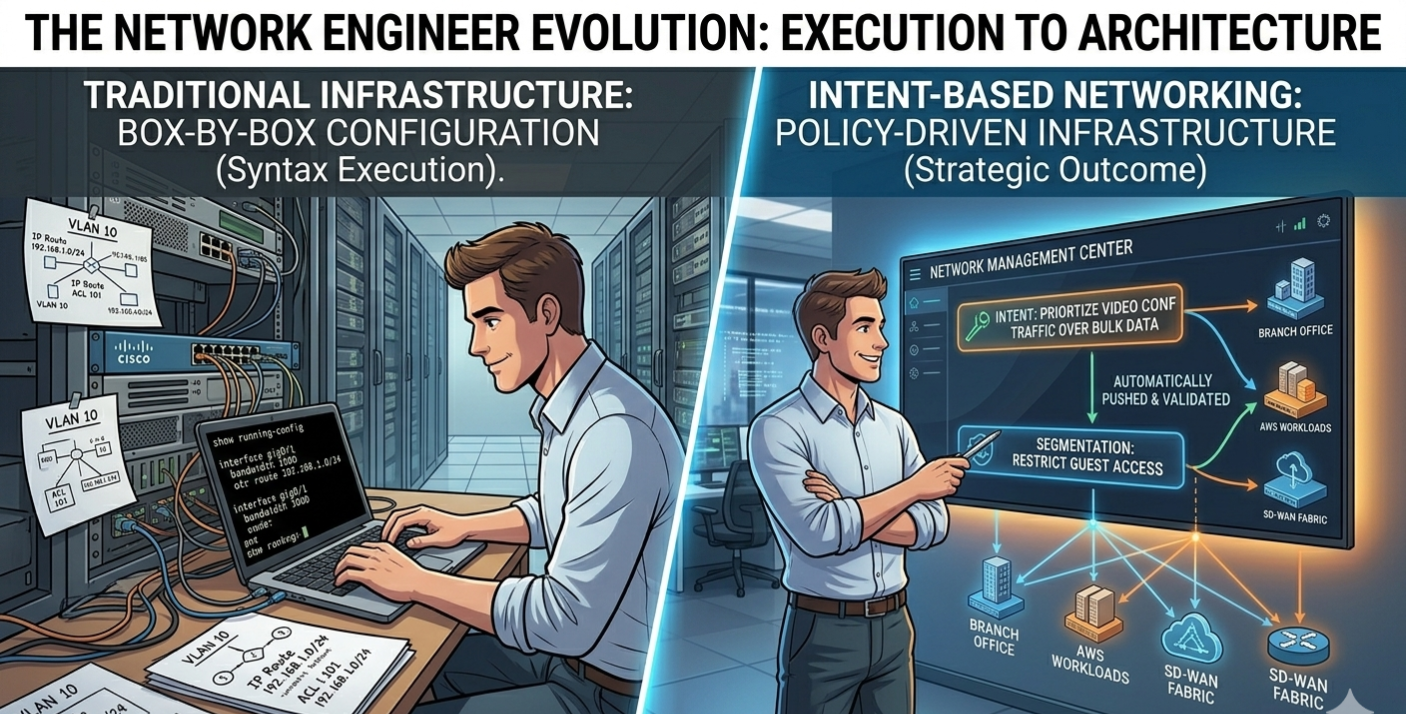
Networking has steadily evolved toward abstraction. In earlier stages, engineers configured devices individually. As environments grew, centralized management tools simplified deployment. The next progression is intent-based networking — a model in which engineers define desired outcomes rather than explicit configurations.
In this framework, the engineer specifies policy objectives such as performance standards, segmentation rules, or security priorities. The system interprets those objectives and automatically applies consistent configurations across the network.
For instance, an organization may require that video conferencing traffic always receives higher priority than bulk file transfers. Instead of manually configuring QoS policies on each device, the engineer defines this intent centrally. The controller distributes and enforces the necessary policies throughout the infrastructure.
The defining characteristic of intent-based networking is continuous validation. Telemetry feeds report whether the intended state is being maintained. If deviations occur — perhaps due to link degradation or unexpected congestion — the system can adjust dynamically to preserve policy objectives.
This approach reduces configuration drift and improves consistency across large environments. However, it increases the need for conceptual clarity. Defining intent requires deep understanding of how routing protocols behave, how security policies interact, and how performance metrics influence user experience.
Abstraction does not eliminate technical depth. It demands it.
Engineers operating in intent-based environments must think strategically. They must anticipate how policies scale, how changes affect redundancy, and how automation interacts with legacy systems.
The industry’s movement toward software-defined infrastructure reflects a desire for agility and precision. Businesses require networks that adapt quickly without sacrificing reliability. Intent-based networking aligns technical implementation with business goals more directly than traditional configuration models.
The professionals who thrive in this environment will be those who understand both layers — the mechanical workings beneath the surface and the policy logic above it.
Networking is becoming less about individual commands and more about defined outcomes. The engineer’s role is evolving accordingly, from executor of syntax to architect of intent.