CCNP Is Not Just Advanced CCNA — It Is a Shift in Thinking
Many professionals approach CCNP with the assumption that it is merely a deeper technical extension of CCNA. More routing protocols, more complex topologies, more advanced commands. While there is certainly greater technical depth involved, the real difference between CCNA and CCNP is not volume — it is perspective.
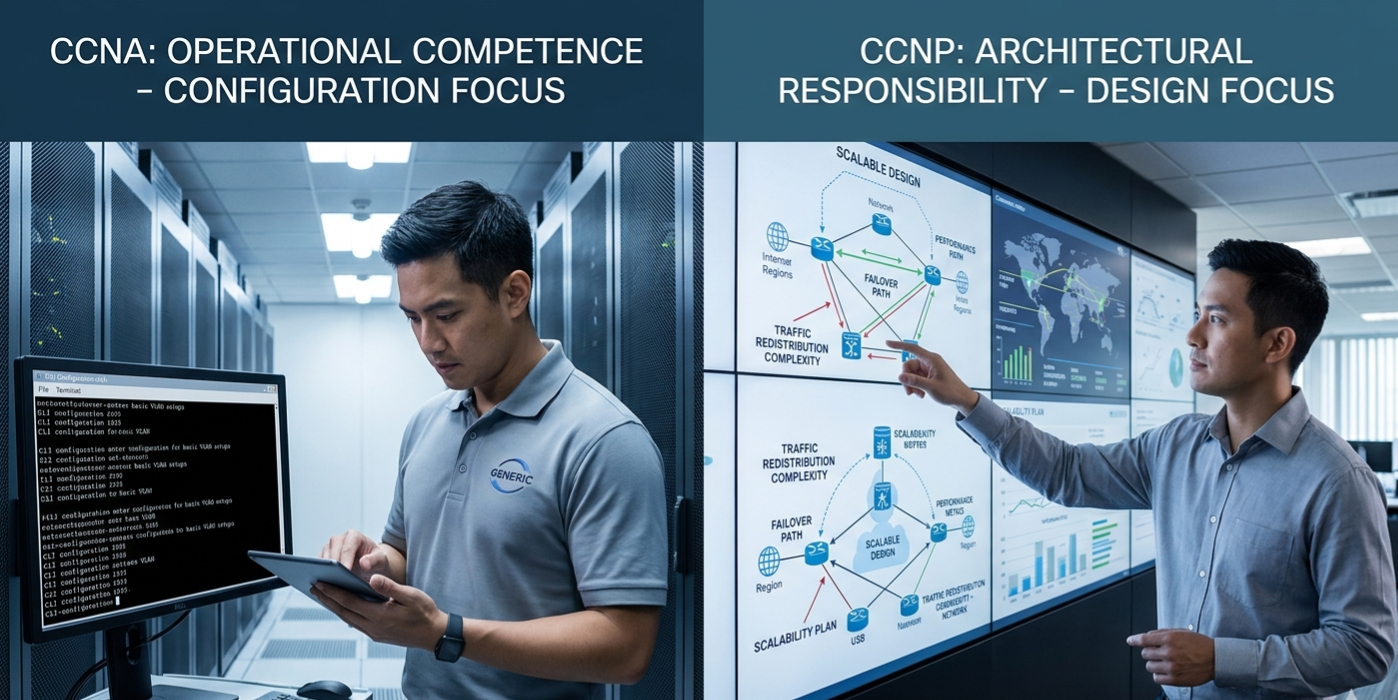
CCNA builds operational competence. It ensures that an engineer understands how networks function at a foundational level. You learn how to configure VLANs, implement routing protocols, perform subnetting calculations, and troubleshoot connectivity. It is structured, methodical, and configuration-focused. The objective is clarity.
CCNP, however, introduces architectural responsibility.
At this level, you are no longer asked simply to configure OSPF; you are expected to evaluate whether OSPF is even the correct choice. You must consider scalability, convergence behavior, failover design, redistribution complexity, and long-term maintenance. Decisions are no longer isolated. Every configuration carries implications for performance, redundancy, and growth.
In professional environments, issues are rarely straightforward. A branch office may report intermittent connectivity every Friday evening. A junior-level response might involve checking logs and restarting interfaces. A professional-level response requires deeper investigation. Questions emerge:
- Is bandwidth saturation occurring during peak business hours?
- Are routing updates fluctuating under heavy traffic load?
- Is asymmetric routing causing session instability?
- Has a recent policy change altered traffic distribution?
CCNP-level thinking means tracing the problem back to design assumptions rather than symptoms. It requires understanding not just how protocols work, but how they interact under stress.
At this stage, engineering becomes strategic. High availability mechanisms such as HSRP, VRRP, or link aggregation are not implemented blindly. They are evaluated against business requirements. Redundancy planning considers failure domains and recovery timelines. Load balancing decisions factor in application sensitivity and cost constraints.
Enterprises value this mindset because network outages directly affect revenue and reputation. The professional engineer must anticipate growth, plan for failure scenarios, and design with resilience in mind. It is less about typing commands quickly and more about ensuring that commands align with long-term objectives.
The transition from CCNA to CCNP marks intellectual maturity. It is the difference between following instructions and making informed decisions. It is the point at which an engineer begins to think like an architect rather than a technician.