Back to Blog
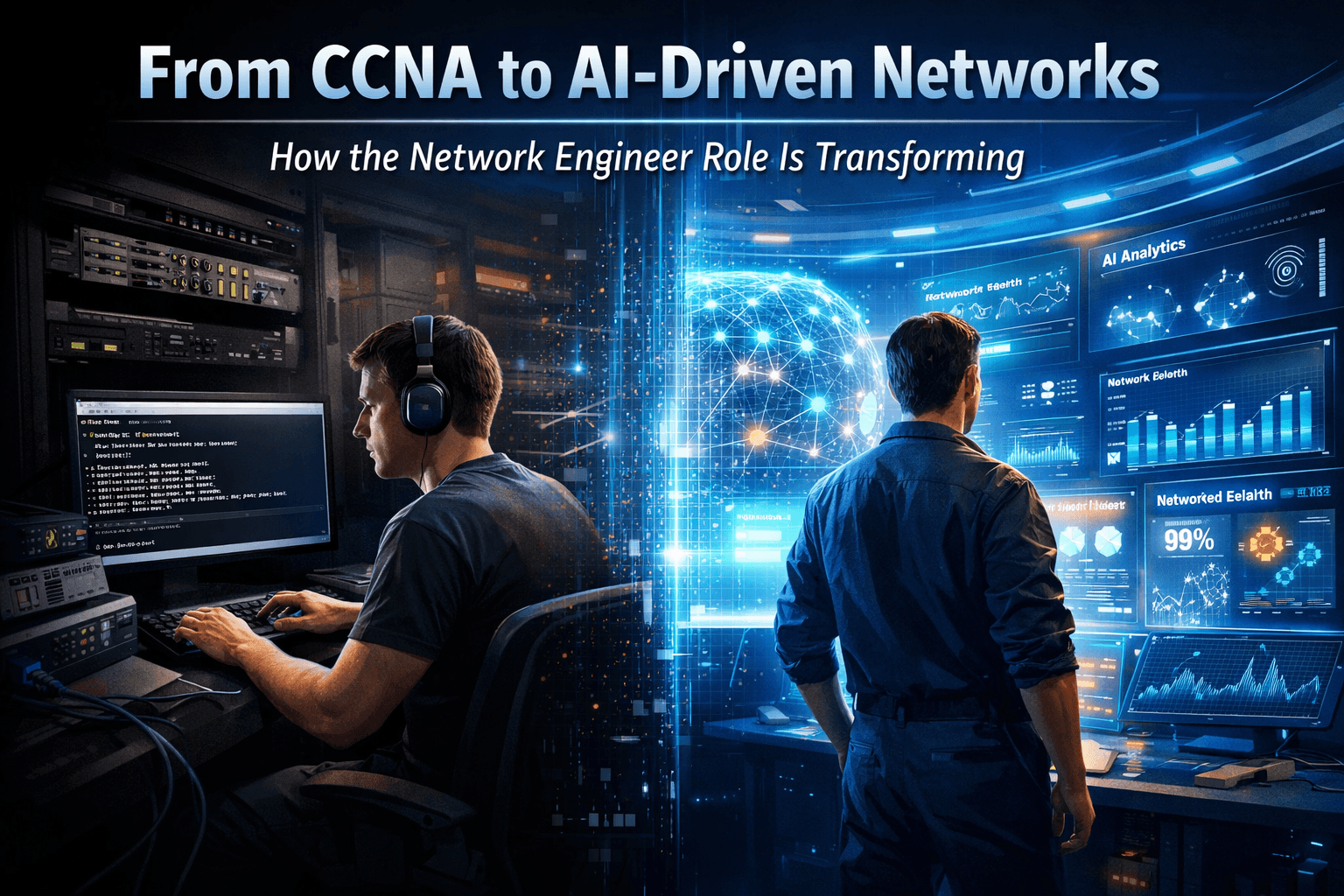
From CCNA to AI-Driven Networks: How the Role of a Network Engineer Is Quietly Transforming
04/06/2026
6 min read
There was a time when networking was purely mechanical. A good engineer was someone who could subnet quickly, configure routing protocols accurately, and restore connectivity under pressure. The command-line interface was the battlefield, and the CCNA certification was the entry pass. It built discipline — understanding IP addressing, VLAN segmentation, static and dynamic routing, ARP behavior, and the logic that governs packet movement from one device to another.
That foundation has not lost its value. In fact, it has become more important. What has changed is the environment in which that knowledge operates.
Enterprise networks today are no longer isolated infrastructures. They are living systems connected to cloud platforms, SaaS applications, distributed workforces, IoT endpoints, and security overlays. Traffic patterns are unpredictable. Workloads shift dynamically. Threat landscapes evolve constantly. In such an environment, manual monitoring and reactive troubleshooting are no longer sufficient.
Earlier, a performance issue would be detected only after users complained. An engineer would log in, check interface utilization, verify routing tables, inspect logs, and gradually isolate the fault. The workflow was reactive and dependent on human observation. Today, intelligent monitoring platforms continuously evaluate telemetry data. They examine latency fluctuations, packet retransmissions, jitter behavior, link stability, CPU trends, and even subtle anomalies in traffic baselines.
When deviations occur, modern systems do not merely generate alerts. They correlate events across devices. They analyze historical patterns. In some cases, they recommend remediation steps or trigger automated scripts. The shift is from problem-solving after impact to anticipating failure before disruption.
However, artificial intelligence does not eliminate the engineer. It elevates the expectation from the engineer.
If a system flags “routing instability,” someone must interpret whether it is caused by:
OSPF metric misalignment
BGP path flapping
Unequal load balancing
A Layer 2 loop influencing control traffic
Or bandwidth oversubscription under peak load
Without understanding routing fundamentals, the dashboard becomes noise.
This is where CCNA still matters. It builds the mental model required to interpret automation outputs intelligently. AI tools rely on structured networking behavior. They assume the engineer understands how protocols converge, how failover mechanisms behave, and how topology influences performance.
The role of the network engineer is therefore expanding. It now includes:
Understanding APIs and telemetry feeds
Interpreting data-driven dashboards
Integrating automation frameworks
Designing scalable and resilient architectures
Aligning network behavior with business priorities
Earlier, value was measured by configuration speed. Today, value is measured by system reliability and predictive design.
The engineer who adapts will move from being a device operator to becoming an infrastructure strategist. Instead of spending hours typing repetitive commands, they will design policies, automate consistency, and analyze performance trends.
Networking is not fading. It is becoming intelligent. And the professionals who combine strong fundamentals with automation awareness and AI literacy will define the next phase of enterprise infrastructure.