Back to Blog
AI Will Not Replace Network Engineers — But AI-Ready Engineers Will Replace Everyone Else.
04/06/2026
5 min read
A few years ago, when cloud started becoming mainstream, people said traditional networking was finished. It wasn’t. Then automation entered the scene, and again the same panic started. Now AI is here — and the fear cycle has restarted. But if you observe closely, technology has never truly replaced engineers; it has replaced outdated skill sets. AI is not here to remove network engineers. It is here to remove repetitive, manual, reactive work.
When I speak with students and working professionals, the real concern is not job loss — it’s irrelevance. And irrelevance doesn’t happen overnight. It happens slowly when we stop upgrading.
Think about what Cal Newport explains in Deep Work: the people who thrive in a distracted, automated world are those who build rare and valuable skills. Networking combined with AI and automation is exactly that — a rare and valuable combination.
Similarly, in The Second Machine Age, Erik Brynjolfsson and Andrew McAfee describe how technology doesn’t simply replace workers; it changes the nature of work. The winners are those who learn to work alongside intelligent machines.
Networking is going through that exact shift.
AI-driven network monitoring, predictive analytics, automated troubleshooting, and self-healing systems are becoming part of enterprise environments. Tools now detect anomalies in traffic patterns before outages occur. Security platforms powered by machine learning identify suspicious behavior in seconds. Network automation platforms reduce manual configuration errors drastically.
But here is what often gets missed in this discussion:
AI does not design network architecture.
AI does not define security policies.
AI does not align infrastructure with business strategy.
Engineers do.
Modern monitoring platforms use machine learning algorithms to detect unusual traffic patterns. If bandwidth spikes abnormally or latency behaves unexpectedly, the system alerts the team before users experience downtime. However, the interpretation of these alerts — and the decision to redesign architecture — still requires skilled network engineers. Cloud platforms integrate AI for workload optimization and traffic balancing. Yet designing a secure Virtual Private Cloud (VPC), implementing segmentation, and integrating hybrid infrastructure still depend on experienced professionals.
In Who Moved My Cheese?, Spencer Johnson describes how those who adapt quickly to change succeed while others struggle. The danger in networking today is not AI — it is complacency.
If a professional believes that mastering static routing and VLAN configuration is enough for the next decade, they are positioning themselves for difficulty. The market is not shrinking, but expectations are rising.
Companies are increasingly searching for:
Network Automation Engineers
Cloud Network Architects
AI-Integrated Infrastructure Specialists
Cybersecurity Analysts with AI tool expertise
This is not job elimination. It is job evolution.
If you search for terms like:
AI in networking
Network automation careers
Future of network engineering
AI in cybersecurity
Cloud networking skills
You will notice growing interest globally. Businesses are investing heavily in AI-powered infrastructure because downtime costs millions, and automation increases efficiency.
The demand for professionals who understand both networking fundamentals and artificial intelligence integration is rising consistently.
This is not speculation. It is industry movement.
In every major technological shift — from virtualization to DevOps to cloud computing — early adopters gained a clear advantage. They were not necessarily the smartest; they were simply proactive.
When companies transition toward AI-driven infrastructure, they prefer engineers who already understand automation logic and intelligent systems. These professionals are easier to upskill further and can lead digital transformation projects.
The salary gap between traditional support roles and AI-integrated infrastructure roles is widening. Organizations are willing to pay more for professionals who can reduce downtime, automate processes, and optimize performance through intelligent systems.
Networking is not dying. It is becoming smarter.
Artificial Intelligence is not eliminating network engineers. It is eliminating repetitive manual effort. It is pushing professionals to think at a higher level — architecture, automation, integration, optimization.
Those who upgrade their skills will experience growth.
Those who remain static may experience pressure.
The choice lies in preparation.
If you position yourself as an AI-ready network engineer — someone who understands automation, cloud networking, cybersecurity integration, and intelligent monitoring — you will not be replaced.
You will be in demand.
Because the future of IT infrastructure is not human versus AI.
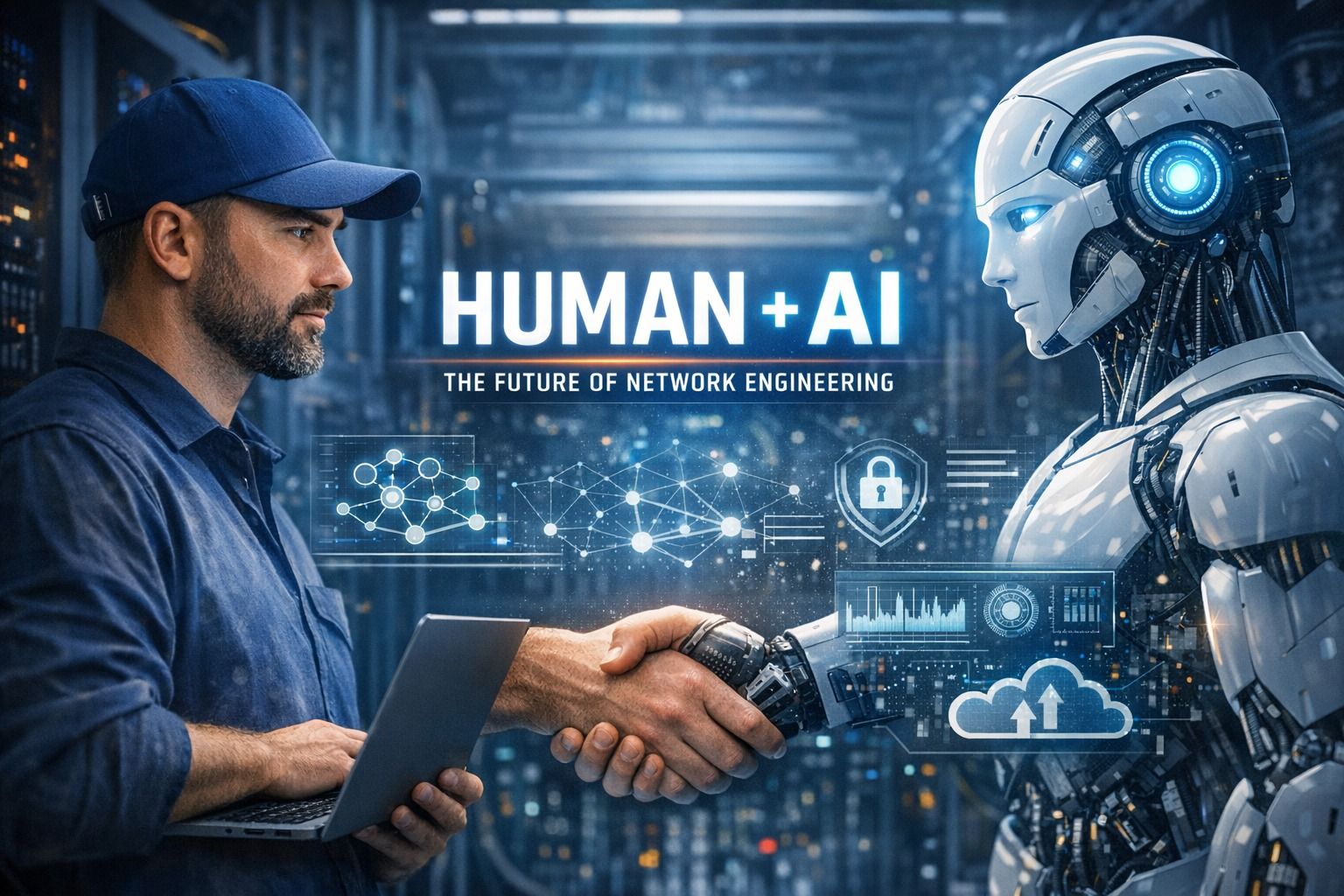
It is human plus AI.
And that combination is powerful.