Artificial Intelligence in Network Troubleshooting: A Tool for Insight, Not Replacement
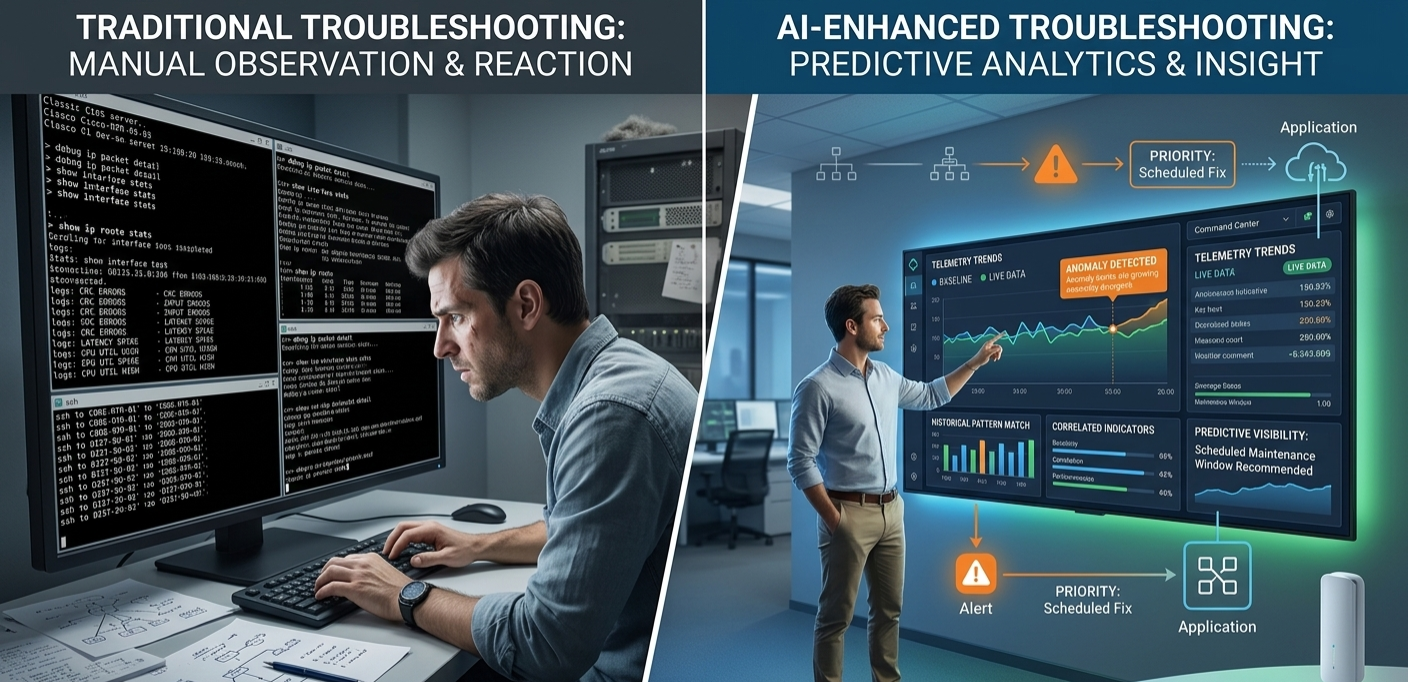
Troubleshooting has always been a defining skill in networking. The ability to isolate faults systematically, interpret packet behavior, and restore stability under pressure distinguishes experienced engineers from beginners. Traditionally, this process relied heavily on manual observation. Engineers would examine logs, analyze routing tables, monitor interface statistics, and progressively narrow down possible causes.
As networks expanded in scale and complexity, this manual approach became increasingly difficult. Modern infrastructures generate massive volumes of telemetry data — latency readings, packet loss statistics, CPU trends, memory usage, route updates, security alerts, and application performance metrics. Sorting through this information manually is not only time-consuming but prone to oversight.
Artificial intelligence introduces analytical capability into this environment. Instead of relying solely on human detection, AI-based monitoring systems continuously compare live data against historical baselines. They detect anomalies that may appear insignificant in isolation but become meaningful when viewed as patterns.
For example, a slight but consistent increase in interface error rates might indicate early hardware degradation. Similarly, recurring fluctuations in routing convergence time could signal instability in upstream connectivity. AI systems can correlate these indicators across devices and highlight trends before a full-scale outage occurs.
The advantage is predictive visibility.
Rather than reacting after users report disruption, engineers can intervene preemptively. Maintenance can be scheduled. Traffic can be rerouted. Configurations can be optimized before performance deteriorates.
However, it is critical to understand that AI does not replace technical expertise. It identifies patterns; it does not comprehend intent. If a monitoring dashboard reports “abnormal latency detected,” the engineer must determine whether the cause lies in:
- Bandwidth oversubscription
- Incorrect QoS prioritization
- Routing asymmetry
- Hardware congestion
- Or external service provider issues
Blindly trusting automation without interpretation can lead to incorrect decisions.
The modern troubleshooting environment is therefore collaborative. Machines analyze data at scale. Engineers apply contextual reasoning. Together, they create a more resilient system.
Professionals who understand protocol behavior, convergence mechanics, and topology design are best positioned to leverage AI effectively. Without foundational knowledge, sophisticated monitoring tools become overwhelming interfaces rather than strategic assets.
The future of troubleshooting is not about abandoning CLI commands or manual verification. It is about enhancing them with intelligent analytics. Engineers remain central to decision-making — but with sharper visibility and faster response capability.